Your Coffee Machine Repaired Quickly and Professionally
Need to have your coffee machine repaired or maintained? We.repair offers expert repairs and preventive maintenance for all brands of coffee machines.
Make an appointment now
Our repair service for coffee machines 🛠️
Whether you have a luxury built-in appliance in your kitchen or a premium freestanding espresso machine, we have the right solution to quickly provide you with a perfect cup of coffee.
Built-in coffee machines: convenient repairs at home in Brussels and Liège
You can't just take a built-in coffee machine out of the wall. That's why our experienced technicians come to your home to diagnose and repair the fault.
We have most original spare parts for brands like Miele, Siemens, and Bosch readily available in our vans, so we can often solve the problem in one visit.
We can already offer our home repair service for built-in appliances in the Brussels and Liège regions.
Freestanding coffee machines: repairs in our workshop in Vilvoorde
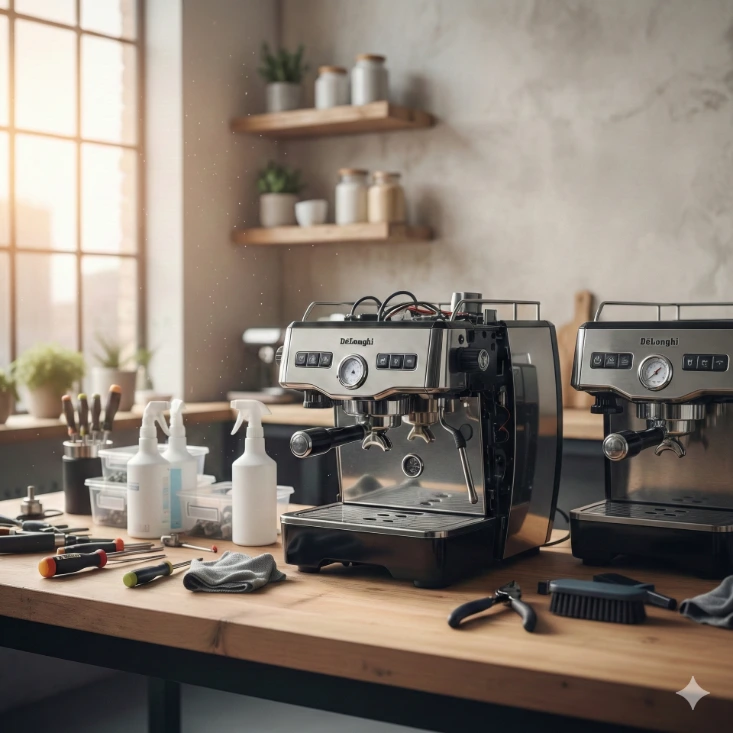
We repair espresso machines of all brands (such as De'Longhi, Jura, Philips, Saeco, Miele, and Siemens) in our workshop in Vilvoorde.
You can drop off your machine during office hours (8:30 AM - 5:00 PM) and pick it up a few days later.
Because a repair, and especially a thorough maintenance of an espresso machine, takes a long time, we repair these machines in our workshop and not at your home.
The Magic of Coffee: How Does an Espresso Machine Actually Work? ☕
While you wait for your repair, it's fascinating to know what goes on inside that compact machine on your countertop. A modern fully automatic espresso machine is actually a small, complex factory.
The Grinder: Everything starts with the beans. The integrated grinder grinds the beans to the exact coarseness. Too fine? Then the coffee becomes bitter. Too coarse? Then it tastes watery.
The Thermoblock: Within seconds, a thermoblock or boiler heats the water to the perfect temperature (ideally between 90°C and 96°C).
The Pump: To extract the aromas and oils from the coffee, a powerful pump forces hot water through the ground coffee at a pressure of often 15 bar (or more).
The Brew Group: This is the heart of the machine. Here, the ground coffee is compressed (tamped) and the actual extraction takes place. This is also the part that requires maintenance most often!
Common Problems & Error Codes (And What They Mean) ⚠️
Even the best machines can have issues. Often, your machine will display an error code or a specific symptom. Here are the most common messages for well-known brands:
Miele Coffee machines
Error code F73 or F74: This usually indicates a problem with the ceramic valve or the drive of the brew group. The machine can no longer find the position of the brew group.
Error code F10: Problem with the water supply. This could be a faulty pump, but first check if the water reservoir is properly seated and the filter is not clogged.
Siemens (EQ-series) & Bosch
Message "Clean brew group" (when it is clean): The sensor that measures the resistance of the brew group detects a problem. Often, the drive mechanism needs to be lubricated or replaced.
Error 8 (or "Call hotline"): A general error for a blocked brew group or a defect in the drive mechanism. Never force the brew group! Our technicians can safely disassemble this.
De'Longhi (Magnifica, PrimaDonna)
General Alarm (Red warning triangle): This means that the brew group is stuck, the inside is extremely dirty, or the heating elements are defective.
"Watercircuit leeg / vul watercircuit": If the reservoir is full but the message remains, there is often an air bubble in the system, the flow meter is defective, or the pump needs replacing.
Jura Coffee machines
Error 8: This is by far the most notorious message with Jura. It means that the brew group is blocked, running heavily, or cannot reach the correct starting position. Because the brew group in a Jura – unlike many other brands – is built-in and cannot be removed by the user, a professional repair or overhaul is required.
Filling system / System empty: This indicates a problem in the water circulation. There may be an air bubble in the pipes, the water filter is saturated/blocked, or it is a sign of heavy limescale build-up preventing the pump from pushing water through the thermoblock.
Message "Empty tray" (when it is already empty): This is usually caused by wet or dirty metal contact points at the back of the drip tray. Clean and dry these contacts thoroughly. Does the message persist? Then the internal microswitch is often defective.
Coffee drips or runs very slowly: Often the grind setting is too fine. If that is not the case? In Jura machines, the metal filter of the built-in brew group often becomes clogged with stubborn coffee oils over time. A professional internal cleaning and overhaul in our workshop works wonders.
Leakage or cold coffee (all brands)
Is there a puddle of water under the machine? Then it is likely that an O-ring or a pipe inside has torn due to limescale. Is the coffee no longer warm? Then the thermoblock is often defective or completely scaled.
Ready to breathe new life into your coffee machine? ✨
Don't be left with weak or no coffee. Make an appointment for a home repair today or bring your appliance to our workshop in Vilvoorde.
Arrange your repair here
Make sure your machine always brews the best cup of coffee: The Ultimate Maintenance Guide for Your Espresso Machine 🧽
Good coffee beans are only half the job. The true secret behind a perfect espresso, cappuccino, or lungo lies in the maintenance of your machine. Residual coffee oils make your coffee bitter over time, and limescale is undoubtedly enemy number one for the lifespan of your device.
With this clear step-by-step plan for your fully automatic espresso machine, you can avoid expensive repairs and keep your coffee tasting as the barista intended.
Daily maintenance: a small effort
A few seconds of work each day makes a world of difference for the hygiene of your machine.
Change the water: Use fresh cold water every morning. Stagnant water negatively affects the taste of your coffee.
Empty the drip tray and residue container: Empty these at the end of the day, rinse them off, and let them dry. This prevents mould from forming on the wet coffee grounds.
Rinse the milk system: Do you enjoy making a cappuccino or latte macchiato? Rinse the milk frother or milk tube immediately after use with hot water. Dried milk residues are a breeding ground for bacteria and cause unpleasant odours and blockages.
Weekly Maintenance: cleaning the brew group
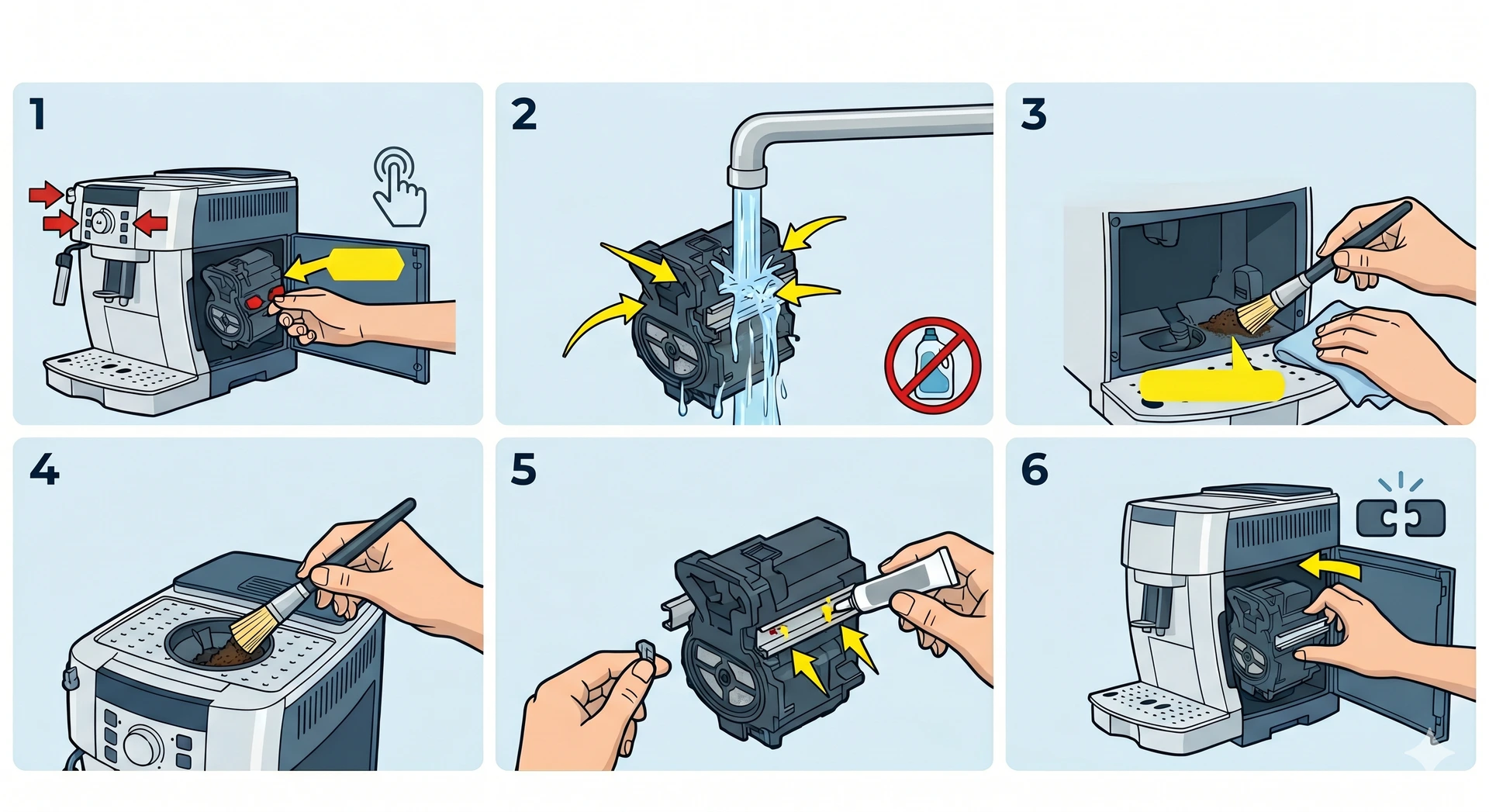
The brew group is the mechanical heart of your coffee machine. With almost all brands (such as Philips, Siemens, Bosch, De'Longhi, and Miele), you can easily remove this yourself.
Remove the brew group from the machine.
Rinse it thoroughly under the tap with lukewarm water. Neverusesoap or washing-up liquid, as this affects the lubrication of the parts!
Allow the brew group to air dry (do not dry it with a towel, as this will leave lint behind) before replacing it.
At the same time, wipe the inside of the machine behind the brew group with a soft cloth to remove any loose coffee residues.
Monthly maintenance: removing coffee fats and oils
Coffee beans are full of natural oils. During grinding and brewing, these fats deposit in the pipes and the brew group. Water alone is not enough to dissolve this.
Use cleaning tablets:Run a cleaning programme on your machine with a specific cleaning tablet. This dissolves the residual coffee fats, restoring optimal flow and bringing back the pure taste of your coffee.
Periodic maintenance: descaling and replacing filters
This is the most important step to keep your device out of our repair workshop! How often you need to descale depends on the water hardness in your area and how intensively you use the device.
Timely descaling: Never ignore the 'descale' light. Limescale builds up around the heating element (thermoblock) and in the fine pipes. This leads to lukewarm coffee, leaks from cracked pipes, and ultimately a defective pump. Always use the descaler recommended by the manufacturer and avoid regular cleaning vinegar (this is too aggressive for the rubber O-rings).
Replacing the water filter: Are you using a water filter in the reservoir? Great! This filters out chlorine and limescale from the water. However, do not forget to replace it every 2 to 3 months (or when the machine prompts you to). A saturated filter no longer works and can even become clogged.
Biannual: lubricating the moving parts
Does your machine have a removable brew group? Then it should move smoothly. Over time and after many rinses, the grease disappears.
Lubricate the guides and the rubber O-rings of the brew group with a thin layer of food-safe silicone grease. This prevents the mechanism from becoming stiff, which can cause creaking noises or error codes.
What if preventive maintenance no longer helps?
Does the coffee not taste optimal despite your good care? Is the water flowing slowly, or do you hear strange noises while grinding the beans? Then your machine probably needs a professional major service.
At We.repair we clean your device ultrasonically, replace dried-out O-rings, calibrate the grinder, and ensure that your machine is as good as new both inside and out. Get in touch and discover our service!
Frequently asked questions (FAQ) about coffee machine repairs ❓
Do you have any questions about our methods or your specific machine? Below you will find the answers to the most frequently asked questions from our customers.
How long does the repair of my espresso machine take?
Forbuilt-in coffee machineswe will come to you and aim to solve the problem directly during our appointment, thanks to our extensive stock of spare parts in the van. Are you bringing afreestanding applianceto our workshop? Then your appliance is usually ready for collection within a week and a half. We will notify you as soon as your appliance is ready.
Is it still worth having my coffee machine repaired?
In most cases: absolutely! Especially with high-quality fully automatic or built-in machines from brands like Miele, Siemens, Jura or De'Longhi, a repair is significantly cheaper than purchasing a new, comparable device. Moreover, you give your device a second life, which is much better for the environment (less e-waste).
Do I get a warranty on the repair?
Yes, quality and trust are our top priorities. At We.repair, you receive a standard 3-month warranty on the repair carried out and on the new parts we have installed. If the same issues occur again within the warranty period, we will resolve this for you free of charge.
Do you also repair devices with capsules or pads (such as Nespresso or Senseo)?
Our expertise and focus are truly on high-end fully automatic bean-to-cup espresso machines and complex built-in coffee appliances. For these advanced machines, our technicians have the right specialized knowledge and the necessary original parts in-house to guarantee you the best possible service.