Washing machine repair in Antwerp
Does someone need to come and repair your washing machine in Antwerp? Our technicians will visit you within 48 hours. Quick diagnosis, fair rates and 3 months warranty.

Are you looking for a solution?
Make an appointment now
Whether you live in "Het Zuid", "Het Eilandje", in "Zurenborg" or in the outskirts, we often come by the next day to repair your washing machine or another appliance. By booking online, you can choose a time that suits you best, without having to make a phone call.



What does it cost to repair your washing machine in Antwerp?
We.repair helps you quickly:
- diagnosis
- we do not sell and aim for a repair
- clear rates
- 3 months repair warranty
- original spare parts
- certified technicians
€69
Diagnosis
We determine the cause of the fault at your home. If you decide not to repair it after the diagnosis (e.g. because the part is too expensive), you only pay for the diagnosis at €69.
+ €110
Repair
If the technician can repair it, you pay €110. There is no maximum on the time. Even a second visit is included. You only pay this when and if it is repaired.
= €179
Fixed repair price
No worries, with We.repair you pay a maximum of €179 (€69 + €110) for a repair.
Even if the technician has a lot of work to disassemble the device and find and solve the problem. Replacement parts are not included. The technician will inform you after the analysis if any parts need to be replaced.
Want to get started or learn more about your washing machine?
Not every fault requires a technician to come to your home. Are you getting a strange error message on the display, is the drum suddenly refusing to turn, or would you prefer to try to solve the problem yourself first?
Because the technology behind a washing machine is the same everywhere – regardless of whether you live in Antwerp or elsewhere – we have gathered all our troubleshooting and maintenance tips in one central place. You will find there, among other things, detailed overviews of error codes for well-known brands such as Miele, Siemens, and AEG.
👉 Discover all our troubleshooting and technical tips on our general washing machine page
Tips for your washing machine
With the advice below from our technicians, you may be able to further improve your washing results and avoid the risk of breakdowns and any resulting repairs.
Read the user manual !
Keep the instruction manual for your language. Place the other languages in a different location or throw them in the recycling.
Place the instructions in your language in an easily accessible location near the device, so that you do not encounter any resistance in finding and reading them.
The water supply tap may eventually become blocked due to limescale buildup.
Therefore, it is good to fully turn the tap off and then back on every 6 months. This helps to dislodge any possible limescale residues and flush them away.
Try often to first solve the problem by turning the device off and on again using the buttons.
Unplug the power supply from the socket, wait 10 seconds, and then plug the power supply back into the socket.
Check the water pressure directly at the tap using a bucket. Contact your plumber if the water pressure is too low.
Also check if the hose is not blocked or kinked.
Clean the filters of the supply hose.
- Turn off the tap
- Select a pre-wash programme and press start
- Stop the programme after 40 seconds.
- Remove the hose from the tap.
- Clean the filter at the top of the Aquastop with a small brush.
- Reattach the hose to the tap.
- It is also advisable to clean the filter in the coupling at the back of the device, where the hose is attached to the device.
- Check if the device's door is properly closed.
- Restart the programme.
Open the tap and watch for leaks.
This is located - depending on the brand - at the front and bottom of the device, behind a small flap.
Clean and unblock your washing machine filter and pump (behind the flap at the front of the appliance):
- Turn off the tap so that no more water can flow into the machine and needs to be drained by the pump.
- Switch off the machine. Unplug it from the socket.
- Also check if the supply hose is not blocked or kinked.
- Open the filter flap, remove it and set it aside.
- Place a tray with a rim (a baking tray from your oven is handy, for example) in front of the appliance to catch the water (note: a relatively large amount of water may flow out).
Sometimes you see a drain hose, which can be used to let water flow into the bowl. First, remove the cap from the hose.
- Perhaps you should empty the tub a few times in between. Note: right after a wash cycle, this water can be very hot.
- Once all the water has been removed, replace the cap on the drain hose and put the hose back in place.
- Carefully unscrew the pump cover and pull it out. Water may spill out!
- Also, unscrew the filter cover.
- In the filter, you may encounter obstacles such as coins, buttons, or clumped textile fibres that you need to remove.
- Clean the inside, the threads of the lid, and the casing of the pump.
- The rotor in the drainage pump must be able to turn freely. Check if that works. Use a spoon or a stick to test it.
- Then screw the filter cover back on tightly.
- Also reattach the pump cover and tighten it securely.
- Put the lid back in place and close it.
- Now you can turn the electricity and the water supply back on.
NOTE: To prevent unused detergent from flowing directly into the drain during the next wash cycle, you must pour 1 litre of water into the detergent drawer through the compartment designated for liquid detergent, and start the drain programme.
Clean and check the rubber seal regularly.
Too much foam can be produced if you wash laundry that is only lightly soiled or if you add too much detergent or use unsuitable/old detergent.
Foam and water can cause the detergent drawer to overflow or leak through the door.
Especially in areas with soft water and when washing lightly soiled laundry, the amount of detergent should be reduced accordingly.
Too much or too little detergent in your washing machine can lead to poor washing results.
When it comes to the correct dosage of detergent, there are three important considerations:
- Look at how dirty the laundry is: the dirtier the clothes, the more detergent is needed to remove the dirt. You may not see it, but about 70% of the dirt in clothing comes from the body, such as skin flakes, sweat, grease, and other bodily substances. Only 30% of the dirt in clothing comes from external sources, such as food, mud, grass, lotions, and creams.
- Look at how much laundry you have: the recommended amounts of detergent are based on the size of the washing machine drum, and there's a good reason for that. The more laundry there is, the more dirt comes with it, so the more detergent is needed to remove it.
- Check the water hardness in your area: hard water contains many minerals, which need to be softened and neutralised for better washing results. That is why detergent manufacturers recommend using slightly more detergent for this than for areas with average water hardness.
It is very tempting to cram as much laundry as possible into the drum of your washing machine, but overloading your washing machine not only significantly reduces washing performance, it can also seriously damage your appliance.
Important reasons to avoid overloading your washing machine:
- The detergent cannot circulate effectively enough to remove dirt and stains. If the washing machine is overloaded, the laundry moves in one large mass, preventing the garments from moving freely in the drum and the detergent from circulating effectively among the laundry to remove dirt and stains.
- The washing machine and the clothes can become damaged. Overloading also increases the pressure in the drum, especially when it spins at high speed, which can cause damage to the bearings and even lead to the glass door breaking. The clothes are pressed against the door seal, and as the drum turns, the clothes rub against the rubber, causing wear and even tears in the clothing.
How do you best load the washing machine?
- When filling the drum, it is important to find the right balance between enough laundry to wash economically and enough space at the top of the drum for an effective wash result.
- For the best washing results, there must be enough water to dissolve the detergent and enough space for your clothes to move. If you overfill the drum, there will be less water available to dissolve the detergent, as the clothes absorb the water.
- Therefore, it is advisable to leave a hand's width of space at the top of the drum above the laundry. This is approximately equivalent to a 3/4 filled drum.
- Having too little laundry in the drum is also undesirable, as it is uneconomical and can result in a loud, banging noise during spinning, because the load is unevenly distributed.
Did you know that ... with a fully loaded machine, the door sometimes doesn't close properly?
Descaling is not necessary when you always dose the correct amount of detergent.
It contains substances that counteract limescale release in hot water.
If you are not sure whether you are dosing correctly or if you have very hard water at home, or especially if you see limescale deposits, you can descale the device with a descaling product.
Low temperatures, especially in combination with an overdose of detergent, can lead to bacteria and odours in your appliance.
Therefore, it is best to do a wash at least once a month at more than 75 degrees.
Do this certainly if the device requests it via a message on the display.
Also regularly clean your soap drawer with warm water.
Depending on your usage, it is best to carry out a deep clean 1 to 2 times a year to remove fats, detergent residues, mould, and similar substances.
Set your device to a cleaning programme, if you have one. If not, use a cotton programme at +60 degrees.
- Sort the white laundry and wash it separately from other colours.
- Use a detergent specifically for white laundry. It contains ingredients that bleach your wash.
- Use the correct amount of detergent according to the level of soiling of the laundry and the water hardness. If the amount of detergent is incorrect, limescale and soap residues may remain on the clothing, which can lead to a greyish colour.
- Make sure that the bottle of detergent is properly sealed. Some bleaching agents can evaporate.
- White towels can be bleached by placing them in a washing basin with 100 ml of water and 200 ml of bleach, and allowing them to soak for 2 hours. After that, wash them in the washing machine at the highest temperature allowed according to the care instructions for the towels..
- Never mix bleach with other chemicals as this can create toxic substances.
- White towels that have turned grey due to limescale deposits can be made white again by washing them in the washing machine with a small amount of citric acid powder or vinegar, instead of detergent.
No, on most devices you cannot change the direction in which the doors opens. Here's why:
Washing machines have a locking mechanism situated on the left side of the front panel.
This locking mechanism is composed of electrical components that cannot be changed from position.
To improve you laundry experience, you can position the washing machine left or right from the dryer in order to get both doors to open outwards
The door of a dryer can usually be inverted.
That way you will be able to transfer the laundry from the washing machine to the dryer with ease.
Quick repairs in Antwerp and the districts
Because our technicians live in the Antwerp region, we are quicker to reach you than other repairers. Whether you live in the busy centre or in the suburbs like Brasschaat, Wilrijk or Edegem, we know the way and the parking challenges.
Whether you live near theSportpaleis, on theEilandje,in the shadow of theCathedral of Our Lady or in the new blocks of Petroleum-Zuid, we are your quick local partner for washing machine repairs (or other appliances).
Electric vehicles
Onze techniekers in Antwerpen maken vaak gebruik van onze compacte 100% elektrische service-wagens om ook via smalle straten en lage parkeergarages vlot tot bij u te raken.
Language
Our technicians speak the language of the Antwerpians.
Quick on-site
Our technicians live and work in the region. They are present somewhere in your area every day for white goods repairs. Our technicians in Antwerp are used to the city centre. It is allowed, but you do not need to keep a parking space free.
We come to repair your washing machine in and around Antwerp
Does your washing machine have a fault in Antwerp-Centre, Wilrijk or Merksem? We offer quick assistance for all brands such as Miele and Bosch for all residents within postcodes 2000 to 2660.
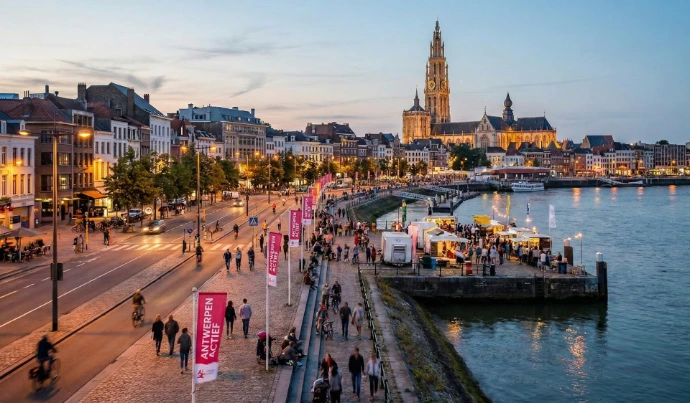
Our engineers are daily on the road in the following districts and suburban municipalities:
Antwerp Centre and Left Bank:
- 2000 Antwerp (Historic Centre, Het Zuid, Sint-Andries)
- 2018 Antwerp (Markgrave, Zurenborg, Haringrode, Stationsbuurt)
- 2060 Antwerp (Dam, Seefhoek, Stuivenberg)
- 2050 Antwerp (Left Bank, Sint-Anneke)
Southern Ring:
- 2020 Antwerp (Kiel, Den Brandt, Polderstad)
- 2600 (Berchem)
- 2610 (Wilrijk)
- 2660 (Hoboken)
Eastern Ring:
- 2100 (Deurne)
- 2140 (Borgerhout)
Northern Ring:
- 2030 Antwerp (Luchtbal, Rozemaai, Haven)
- 2170 Merksem
- 2180 Ekeren (and Mariaburg)
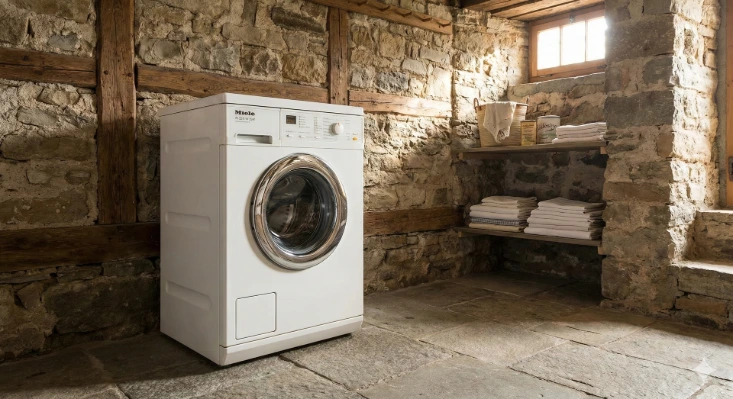
Sustainable repair
Repairing often saves 43kg of CO2 compared to buying a new appliance from the local electrical store.
Frequently asked questions answered
Answers to frequently asked questions
We offer a fast in‑home repair service throughout the entire city of Antwerp and all surrounding districts. Our technicians are on the road daily within the following zones and postal codes:
Antwerp City Centre & Left Bank: 2000, 2018, 2050 and 2060 (including Het Zuid, Eilandje and Seefhoek).
Antwerp North: 2030 (Luchtbal), 2170 (Merksem) and 2180 (Ekeren).
Antwerp East: 2100 (Deurne) and 2140 (Borgerhout).
Antwerpen South: 2020 (Kiel), 2600 (Berchem), 2610 (Wilrijk) en 2660 (Hoboken).
Is your postcode not listed? Do you live just outside the city in the Antwerp suburbs (such as Brasschaat, Schoten, Hove or Mortsel)? No worries, we come there too! Check our page for the broad Antwerp region.
Our Miele repair service in Antwerp can repair Miele appliances. Our professional technicians are well trained and have access to the latest technical information from Miele and all parts.
Our Bosch white goods repair service in Antwerp can repair Bosch appliances. Our professional technicians are well trained and have access to the latest technical information from Bosch and all parts.
Our technicians repair Siemens appliances in Antwerp. Our professional technicians are well-trained and have access to the latest technical information from Siemens and all parts.
Our technicians repair AEG and Electrolux appliances in Antwerp. Our professional technicians are well-trained and have access to the latest technical information from AEG or Electrolux and all parts.
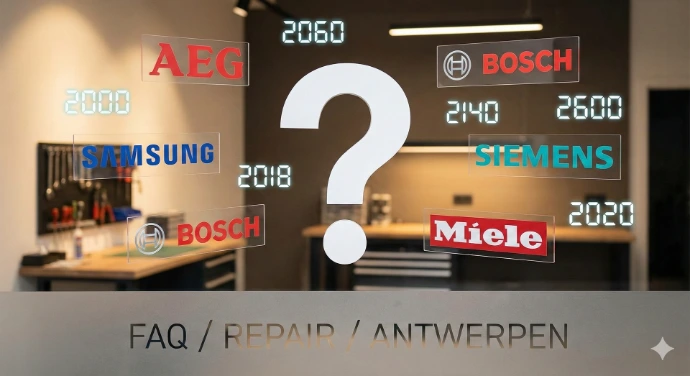
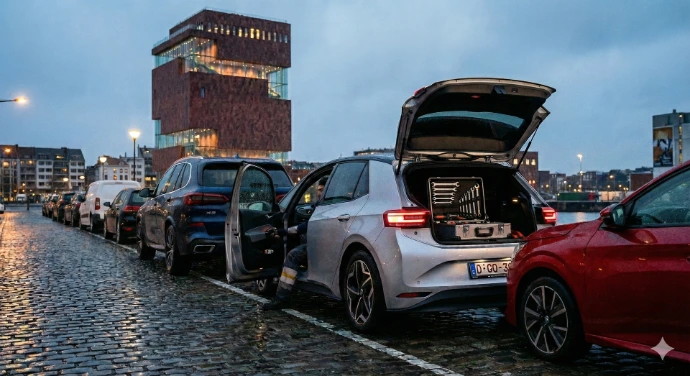
Fast white goods service from Eilandje to Wilrijk
Our technicians are present every day in all Antwerp districts. Whether you live in an apartment in the Zuid and your dishwasher is leaking, or you need a repair for your tumble dryer on the outskirts of Merksem or Ekeren — we know our way around. Thanks to our local presence, we can often provide a diagnosis within 24 hours, without you having to worry about the parking congestion around the Meir or the Leien.
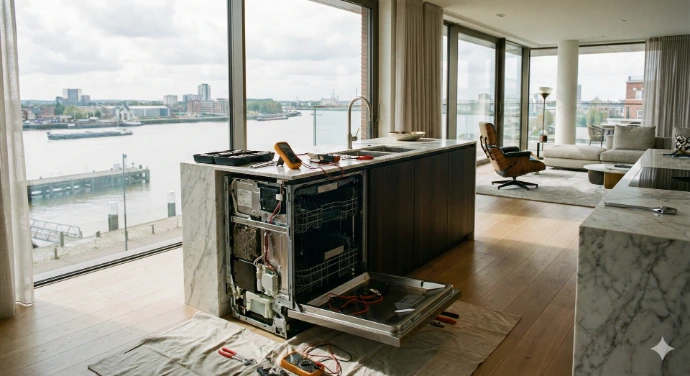
Uw vertrouwde Miele of Bosch weer als nieuw in uw appartement
Many Antwerpians choose quality. Do you have an older Miele washing machine that shows an error code or a Bosch washing machine that no longer heats? Don't throw them away! We specialize in extending the lifespan of quality brands. Our technicians have the most common parts for German and European brands readily available.
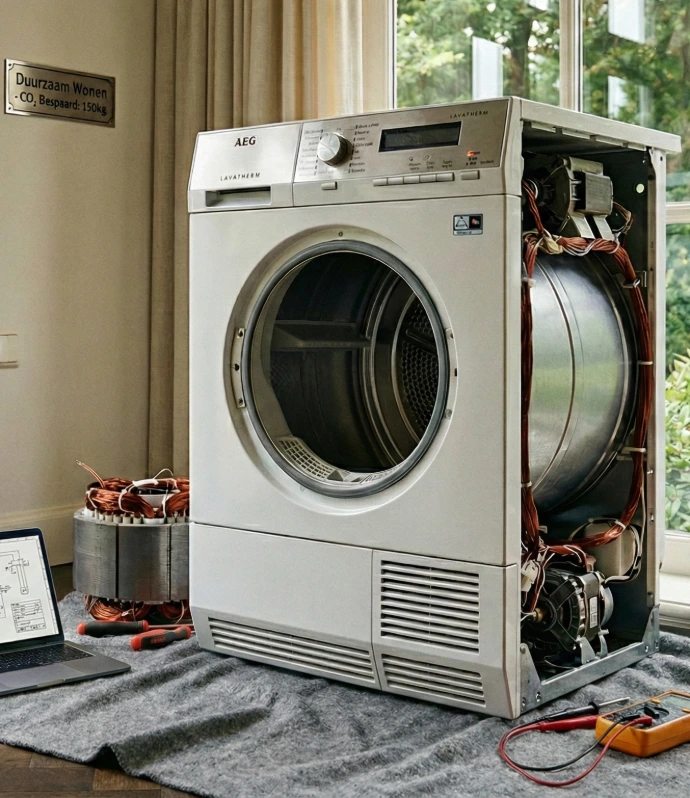
Why have your appliance repaired instead of buying new?
In a city like Antwerp, the temptation is great to quickly drive to an electronics store on the Meir or in the outskirts for a new appliance. However, a repair by WeRepair is almost always the smarter and greener choice.
3. Save on "Antwerp Logistics"